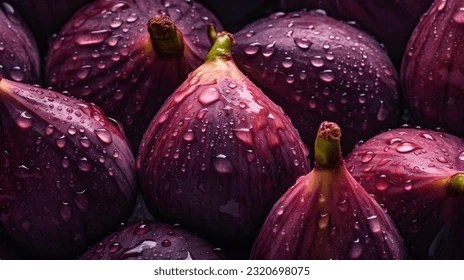
From Palestine to Sheffield – the journey of the sensual fig.

“Then Isiah said. Take a cake of figs.” Kings 20.7

Although fig rolls originated in Egypt, created by wasp haters, slowly by centuries and miles they became a classic biscuit and made their way to the Industrial North of England – Sheffield. How did this happen?

How could the fruit of a plant that had its very roots in the Garden of Eden travel so far from home and thrive in what was once a phosphorus smog filled city called Sheffield? A place described by George Orwell in 1936 – “And the stench! If at rare moments, you stop smelling sulphur it is because you have begun smelling gas. Even the shallow river that runs through the town is-usually bright yellow with some chemical or other. Once I halted in the street and counted the factory chimneys, I could see;” 

The fruit of a fig has its very own insect to pollenate the fruits. Unsurprisingly they are called fig wasps. And each variety of fig has its own special little wasp. There are nine hundred species of figs and so of course nature dictates there must then be nine hundred species of fig wasps.

Figs or fig trees are mentioned in the Bible almost two hundred times. Even Jesus mentions them. It makes sense that the tree would travel through the desert with the Israelites and thrive in Egypt.

As previously mentioned, it was here in Egypt that the wasp haters invented fig rolls. Hieroglyphics in the tombs in the Valley of the Kings show the harvesting of figs and it is common for dried figs to be among the items archaeologists find on their digs. Tutankhamun’s rolls would be different from todays; the process would be similar. The preserved figs would have been hand rolled with honey and spices in a floury dough and baked.

How did the fruit get to Britain, well as usual via the Romans. But it was from figs already pollinated so the assumption is there were no fig wasps in the country back then and therefore no cultivated trees. In 1552 Cardinal Pole -later to become the Archbishop of Canterbury planted a fig tree in the garden of Lambeth Palace, brought back from his time in Italy.

By the 17th century figs trees were common. Fig rolls at this stage were made at home. There are several theories on the origins of fig rolls being commercially produced, with different countries and companies claiming to be the creators.

Two main contesters for the accolade are McVitie’s and Jacobs.

Some historians believe that the Scottish biscuit company McVitie’s created the first fig rolls in the late 19th century. Developing a recipe for fig rolls that consisted of a sweet pastry filled with fig jam, and the company began mass-producing the pastry in the early 20th century.

However, there is also a school of thought which suggests that the Irish biscuit company Jacob’s created the first fig rolls in the early 20th century. Jacobs developed a recipe for fig rolls that again consisted of a sweet pastry filled with fig jam, and the company began mass-producing the pastry in the 1920s.

What is certain is that by the early 20th century they were a popular biscuit in the UK and throughout the World.

One section of society where they were extremely popular were the working classes. A convenient and affordable treat and the steelworkers in Sheffield were no exception. Once eaten the fig seeds would pass through the digestive system into the sewers and whenever there was a heavy storm a substantial proportion of the sewage overflowed into the river Don.

It is as this stage the vagaries of steel working came into play. The waters of the River Don were at a constant 20 degrees creating perfect conditions for the fig seeds to germinate and grow.

It is a very strange combination for such an exotic fruit to have survived in such a toxic unwelcoming environment as the Industrial North, human appetite, imperfect sewage, and the steel industry.

Today there are many distinct types and variations to choose from, each with its own unique characteristics and ingredients. Some of the most popular types of fig rolls include:

  • Traditional fig rolls, which consist of a sweet pastry filled with fig jam.
  • Nut-filled fig rolls, which are filled with nuts and spices.
  • Sweet fig rolls, which are filled with sweet fig jam and topped with sugar.

Fig rolls played a significant role in British cuisine and culture, particularly in the late 19th and early 20th centuries. They were seen as a quintessential British snack food, and their popularity was closely tied to the country’s industrial and cultural heritage. Fig rolls were often associated with traditional British values such as thriftiness, simplicity, and practicality, and they were seen as a comforting and familiar treat that could be enjoyed by people of all ages and backgrounds. The popularity of fig rolls also reflected the British love of sweet and savoury flavours, as well as the country’s rich tradition of baking and pastry-making.

Figs have been mentioned in literature and poetry for centuries including Shakespeare, Chaucer, Dickens, and D H Lawrence.

It is possible to create delicious and authentic-tasting fig rolls in your own kitchen. To make fig rolls at home, you will need to start by making the dough, which typically involves combining flour, water, and yeast, and then kneading the mixture until it becomes smooth and elastic. The filling can be made by cooking down fresh or dried figs with sugar and spices and then mixing in other ingredients such as nuts or seeds. The dough and filling are then assembled and baked until golden brown, resulting in a delicious and flaky pastry.

But make sure to use high-quality ingredients, including fresh figs and real butter or oil, to give your fig rolls the best possible flavour and texture. Second, be patient and do not rush the process, as making fig rolls can be a time-consuming and labour-intensive process. Third, experiment with different ingredients and flavour combinations to find the one that works best for you. Finally, do not be afraid to try again if your first batch of fig rolls does not turn out as expected.

Today if walking along the river towards Meadowhall, there are about thirty mature fig trees, some about 70 years old. A local Sheffield naturalist and amateur industrial historian Richard Doncaster discovered these. He along with a local botanist Margaret Shaw, fellow botanists from the Sorby History Society investigated the trees and confirmed they were indeed Fig trees and had the trees registered to ensure their protection.

From Palestine to Sheffield – the journey of the sensual fig.

“Then Isiah said. Take a cake of figs.” Kings 20.7

Although fig rolls originated in Egypt, created by wasp haters, slowly by centuries and miles they became a classic biscuit and made their way to the Industrial North of England – Sheffield. How did this happen?

How could the fruit of a plant that had its very roots in the Garden of Eden travel so far from home and thrive in what was once a phosphorus smog filled city called Sheffield? A place described by George Orwell in 1936 – “And the stench! If at rare moments, you stop smelling sulphur it is because you have begun smelling gas. Even the shallow river that runs through the town is-usually bright yellow with some chemical or other. Once I halted in the street and counted the factory chimneys, I could see;” 

The fruit of a fig has its very own insect to pollenate the fruits. Unsurprisingly they are called fig wasps. And each variety of fig has its own special little wasp. There are nine hundred species of figs and so of course nature dictates there must then be nine hundred species of fig wasps.

Figs or fig trees are mentioned in the Bible almost two hundred times. Even Jesus mentions them. It makes sense that the tree would travel through the desert with the Israelites and thrive in Egypt.

As previously mentioned, it was here in Egypt that the wasp haters invented fig rolls. Hieroglyphics in the tombs in the Valley of the Kings show the harvesting of figs and it is common for dried figs to be among the items archaeologists find on their digs. Tutankhamun’s rolls would be different from todays; the process would be similar. The preserved figs would have been hand rolled with honey and spices in a floury dough and baked.

How did the fruit get to Britain, well as usual via the Romans. But it was from figs already pollinated so the assumption is there were no fig wasps in the country back then and therefore no cultivated trees. In 1552 Cardinal Pole -later to become the Archbishop of Canterbury planted a fig tree in the garden of Lambeth Palace, brought back from his time in Italy.

By the 17th century figs trees were common. Fig rolls at this stage were made at home. There are several theories on the origins of fig rolls being commercially produced, with different countries and companies claiming to be the creators.

Two main contesters for the accolade are McVitie’s and Jacobs.

Some historians believe that the Scottish biscuit company McVitie’s created the first fig rolls in the late 19th century. Developing a recipe for fig rolls that consisted of a sweet pastry filled with fig jam, and the company began mass-producing the pastry in the early 20th century.

However, there is also a school of thought which suggests that the Irish biscuit company Jacob’s created the first fig rolls in the early 20th century. Jacobs developed a recipe for fig rolls that again consisted of a sweet pastry filled with fig jam, and the company began mass-producing the pastry in the 1920s.

What is certain is that by the early 20th century they were a popular biscuit in the UK and throughout the World.

One section of society where they were extremely popular were the working classes. A convenient and affordable treat and the steelworkers in Sheffield were no exception. Once eaten the fig seeds would pass through the digestive system into the sewers and whenever there was a heavy storm a substantial proportion of the sewage overflowed into the river Don.

It is as this stage the vagaries of steel working came into play. The waters of the River Don were at a constant 20 degrees creating perfect conditions for the fig seeds to germinate and grow.

It is a very strange combination for such an exotic fruit to have survived in such a toxic unwelcoming environment as the Industrial North, human appetite, imperfect sewage, and the steel industry.

Today there are many distinct types and variations to choose from, each with its own unique characteristics and ingredients. Some of the most popular types of fig rolls include:

  • Traditional fig rolls, which consist of a sweet pastry filled with fig jam.
  • Nut-filled fig rolls, which are filled with nuts and spices.
  • Sweet fig rolls, which are filled with sweet fig jam and topped with sugar.

Fig rolls played a significant role in British cuisine and culture, particularly in the late 19th and early 20th centuries. They were seen as a quintessential British snack food, and their popularity was closely tied to the country’s industrial and cultural heritage. Fig rolls were often associated with traditional British values such as thriftiness, simplicity, and practicality, and they were seen as a comforting and familiar treat that could be enjoyed by people of all ages and backgrounds. The popularity of fig rolls also reflected the British love of sweet and savoury flavours, as well as the country’s rich tradition of baking and pastry-making.

Figs have been mentioned in literature and poetry for centuries including Shakespeare, Chaucer, Dickens, and D H Lawrence.

It is possible to create delicious and authentic-tasting fig rolls in your own kitchen. To make fig rolls at home, you will need to start by making the dough, which typically involves combining flour, water, and yeast, and then kneading the mixture until it becomes smooth and elastic. The filling can be made by cooking down fresh or dried figs with sugar and spices and then mixing in other ingredients such as nuts or seeds. The dough and filling are then assembled and baked until golden brown, resulting in a delicious and flaky pastry.

But make sure to use high-quality ingredients, including fresh figs and real butter or oil, to give your fig rolls the best possible flavour and texture. Second, be patient and do not rush the process, as making fig rolls can be a time-consuming and labour-intensive process. Third, experiment with different ingredients and flavour combinations to find the one that works best for you. Finally, do not be afraid to try again if your first batch of fig rolls does not turn out as expected.

Today if walking along the river towards Meadowhall, there are about thirty mature fig trees, some about 70 years old. A local Sheffield naturalist and amateur industrial historian Richard Doncaster discovered these. He along with a local botanist Margaret Shaw, fellow botanists from the Sorby History Society investigated the trees and confirmed they were indeed Fig trees and had the trees registered to ensure their protection.
Tales from the badger set.

“Spring was moving in the air above and in the earth below and around him, penetrating even his dark and lowly little house with its spirit of divine discontent and longing.” ― Kenneth Grahame, The Wind in the Willows

It seems fitting to start an article about badgers with a quote from Wind in the Willows, for it was with this book published in 1908 that the badger’s connection with the landscape and the people of Britain changed.

With Mr. Badger, Kenneth Graham created a character that slowly won the hearts of us all and eventually the badger became one of our most enigmatic wild animals in the UK.

Yet for many, the only time they see a badger is sadly on the side of the road dead. Whenever I speak to work colleagues I am reminded of Alan Bennet when his friend hits a badger whilst driving and after returning to the scene of the crime Alan realised that – “What particularly upsets him is that I have never seen a live badger – all the badgers I have seen like this one is now, a dirty corpse by the roadside. We drive on in sadness and silence.” ― Alan Bennett, Keeping On Keeping On

I am one of the fortunate ones for can I see badgers every day. Or every evening to be pedantic. When I first moved into the place I live now, I chose it because I was not a social person. I wanted to be close to my place of work but away from people and what I found instead was badgers.

My garden was part of those ancient badger tracks that meant manicured lawns and tarmacked drives would not and could not stop the journey that was imprinted in the very psyche of this strange allusive anti-social animal.

The first night I heard the sound of a badger shuffling through my place, I thought I was being broken into. The banging into the man-made structures of my home sounded like a burglar on a mission to just break in, take what they wanted and leave.

But when I looked out into the dusky darkness what I saw enthralled and delighted me, first I saw the grey shape of what appeared to be a cat with a stunted tail, and then the creature turned and I saw the face of a humbug.

I could barely contain myself a badger! The creature that so many bemoan about seeing dead by the road side was here very much alive in my garden, and very much on a mission to break into my home. And he was about six foot away from me.

And so it was from then, that my fascination with badgers started. I have to confess my first tactic was peanut butter sandwiches. Why? What myth or legend or story said badgers like peanut butter sandwiches? But they certainly did love them and that first night that is what I fed them.

Or to be precise I fed one. I never named my badgers, I notice that on blogs people name their badgers, but I just had a sense from the start they are wild. My first burglar badger 20 years ago, my sister called Jack until the time the two first cubs came down and so Jack became Jill.

Jill was not a good mother, the cubs died before the daffodils had barely danced and waved across the craters of the moon that now represented my garden. But I made the mistake of naming one, a scar faced male badger who lived, loved and fought on my now desolate land.

I worked long hours in those days and often at night completely shattered I would slowly walk back to my home to find a garden of badgers. Like a bag of humbugs thrown out of a bag they snuffled across the craters that should have been a lawn. And I would have to walk past them to get to my door.

Most showed indifference, they would raise their stripped heads and sniff the air, and then just ignore me, except one, who would catch my scent, Scar Face. And as I attempted to reach the door he would suddenly rear his head and like a tank barge his way towards me. I would just make it to a place of safety and shut the door.

If you want to anthropomorphic an animal then I did that with Scar Face. He was like the angriest belligerent teenage son you could have. One morning I heard what sounded like a raging bull kicking his way out of the enclosure into the rodeo. Scarface had got into the recycle wheelie bin and I had to get him out.

A battle that I did not want, a battle he felt he needed to win, but both reduced to compromise by a green plastic bin. He roared out of that prison like the wild animal he was.

And then I found him by the road side discarded like the grubby grey rug that Alan Bennett described. I recognised him by the scars, the years of fights etched on his face like medals. My last and first badger that ever I named lying dead on the road.

For they are wild animals. How many writers have given these wonderful secretive creatures characters like humans? Kenneth Grahams Mr Badger was just the start.

The first book at school that I brought was Watership Down and in that book there was a portrayal of a badger that was not wise and kind. He was the wild creature that he was born to be.

“Full of savage cunning”. He was wild, he was not a creature you would have in your living room. He was not the Mr. Badger of Kenneth Graham, that when Mole and Rat knocked on his door he so warmly but also so gruffly welcomed into his home.

And of course that is the reason he became the hunted, the animal no one could understood, the animal that would be blamed for all the problems that man encountered in the country side.

And this echoes the lines of poets like John Clare – Badger –

“When midnight comes a host of dogs and men Go out and track the badger to his den, And put a sack within the hole, and lie Till the old grunting badger passes bye.”

Badger baiting has survived into the 21st century. The most brutal practice – it is rather like fox hunting when Oscar Wilde said “the unspeakable In pursuit of the uneatable”

There are two things that a badger is afraid of – a man and a dog. For badgers, the two are merely extensions of the other. And ultimately it is the dog that pits its strength and wits against the badger. The man merely provides the circumstances to make it possible and becomes the malignant observer to the barbarity.

Badger baiting was very much the domain of the working class, in contrast to fox hunting which was for the landed gentry. Badger baiting was the opportunity for the uneducated and poor to take control of their own free time and inflict cruelty on a creature that the rich had no interest in and so therefore would never obstruct their sport.

Even today “badger experts” say, it can be a housing estate thing. They tend to be very vocal about their activities unlike country people who do it quietly.

It was never was it about feeding the poor. Except oddly people do actually eat badger – badger ham. This was something that I only found out 20 years into watching and feeding badgers, there are people that actually eat them. Those who have eaten it say it tastes like pork but sweeter.

There is a recipe from Germany that details how to boil badger meat with pears. And a century ago in England a badger feast was not unheard of. I have never heard anyone say to me they actually like it enough to eat it twice though.

And yet today we have culls to kill badgers purely to eradicate Bovine TB. Despite there still no conclusive proof that culls help eradicate Bovine TB the licence to cull badgers went ahead again in 2021.

So we have reached the strangest juxtaposition, we love badgers, but we are culling badgers, we run over badgers but we feed badgers peanut butter sandwiches.

Looking out on a foggy winter’s morning into my garden, I can see the remnants of the previous night’s badger’s feast. They had discarded the spring green leaves and tossed aside various items of food. But had snuffled their way through the bread with the meat fat poured over it.

Also chicken carcasses they love. It is eaten with enthusiasm, a great deal of noise, grunting and a crunching of bones. And of course my peanut butter sandwiches.

Yet whenever I hear about people that feed badgers it appears their badgers will eat anything. Mine must be Surrey Badgers, fussy eaters.

My abiding memory of a badger as a child was when reading Watership Down, Violet says – “It has just killed. I saw blood on its lips”

And Dandelion replies,” Lucky for us it had, otherwise it might have been quicker!”

To be fair they don’t seem to be that fast in my garden these days. But I do remember Scar Face pummelling towards me, like a Sherman tank that late summer evening, so many years ago. And having the battle with him stuck in my weelly bin.

And I think, stay wild.

“I’m a beast. I am and a Badger what’s more. We don’t change. We hold on.” CH Lewis

Please don’t change Mr. Badger, for you are the Story Teller of the Animal Kingdom. And what stories they have to tell.

The dark side of Christmas past.

“You better be good for goodness sake.”

For most people in the West, Christmas is a time of joy, of celebration, overeating, over drinking, repeats of dodgy films and overspending. In all honesty for me I just feel like I just want to go into a voluntary lockdown and not reappear until the 7th day of the new year.

But Christmas wasn’t always like what we have in Europe today. It was a worse, much darker, scary and dangerous celebration.

The inspiration for Santa Claus in European tradition was St Nicolas of Myra (Lycia), the Patron Saint of Children. On the 6th December he died and the legend of Santa Claus began. St Nicolas would travel to children’s homes and if they had been good he would leave a present under their pillow.

But tradition has it he had a more sinister companion, called in Germany Knecht Ruprecht , Zwarte Piet (Black Pete) in the Netherlands and Krampus in the Central and Eastern Alps. Krampus is believed to come from the German word, claw.

Knecht Ruprecht (Servant Rupert was first mentioned in a Christmas parade in Nuremburg in the 17th Century. He was a scary character described as having a long black beard, wearing a dark robe and carrying a sack of ashes.

On the 5th December he would visit the homes of children in Northern and Central Germany. He would ask children if they could recite their prayers. If the child could then they are rewarded with apples, nuts and gingerbread. If no then he would beat them with his sack of ashes. If they were really naughty then would be abducted and taken to Ruprecht’s home somewhere in the Black Forest either to be eaten or tossed into the river.

It is no more cheerful in the Netherlands tradition of Zwarte Piet. Black Pete appeared as his name implies a black faced character with large gold earrings and very exaggerated lips. In a similar vein he is Santa Claus’s helper.

The earliest written evidence of his appearance is in the 15th Century. He was associated with pirates and again there was the threat that he would abduct naughty children take them to a hide out and beat them. The large bag was used to stuff the children in for the trip.

In the days leading up to 5th December Cities and towns across the Netherlands dress up as Piet. And this has meant he has become a controversial political figure. The parades now often take on a violent and political tone. And there are many parades that have tried to transform him into “Chimney Pete” has has soot on his face.

Austrian children do not escape the alter ego of St Nicolas. If they have been bad then they will get a visit from Krampus. He takes on the appearance of a half man half goat. With a long tongue, fangs, and devil eyes.

Again he is a monster that punishes naughty children. He beats them with sticks, eats them or takes them back to hell with him. The luck ones wake up the next day with with a present. The not so fortunate bruised and terrified or on their way to hell.

A festivity to celebrate this devil is known as the Krampus run. It usually involves copious amounts of alcohol. People dressed up as Krampus parade through the streets of Austria and German scary spectators.

Although the run began relatively late in the traditions of Christmas – the late 20th century they have become more and more popular. Some have claimed that the popularity of the event is a reaction to the commercialization of Christmas.

Not to be out done France has Pere Fouettard Father Whipper. Nancy in the Lorraine region of France biggest day of the year have their very own Christmas Cannibal of France. He is a whip wielding butcher and he attempts to eat children.

The modern re- enactment of the tradition sees three local children visit the butcher and are depicted being sliced, quartered and salted. Fortunately St Nicolas arrives to resurrect them. Somewhat traumatized by the whole proceedings I would assume. And then Pere Fouettard runs through the crowd giving out coal and sometimes turnips and potatoes.

In the Middle Ages, Olaus Magnus the Swedish Cartographer believed that in Prussia, Livonia and Lithuania werewolves gathered on Christmas night and then spread out to “rage with wondrous ferocity against human beings…for when a human habitation has been detected by them isolated in the woods, they besiege it with atrocity, striving to break in the doors and in the event of doing so, they devour all the human beings, and every animal which is found within.” At a certain castle the monsters held werewolf games and those too fat to leap over a wall were eaten by their fitter comrades.

It was also a medieval belief in Latvia and Estonia that “at Christmas a boy lame of leg goes round the country summoning the devil’s followers, who are countless, to a general conclave. Whoever remains behind, or goes reluctantly, is scourged by another with an iron whip….The human form vanishes and the whole multitude becomes wolves.” This transformation lasted for twelve days.

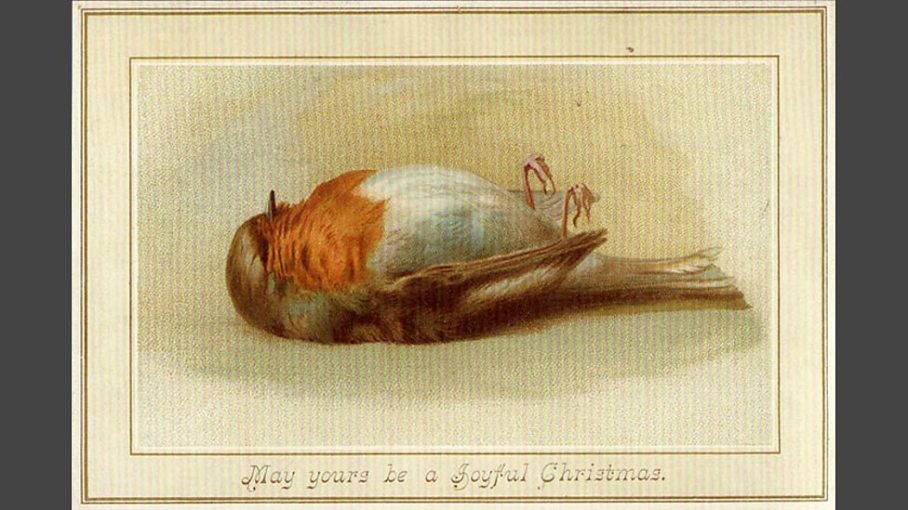
Those stuffy Victorians had their own idea of what constituted as a Merry Christmas, as reflected in their bizarre Christmas Cards. In the Museum of London there are Christmas cards depicting dancing stag beetles, clowns beating up policemen, hares riding penny farthings, a polar bear devouring an unsuspecting Christmas reveller. Pictures of dead robins with the message “Calm decay and Peace Divine” and my personal favourite mice feasting on a cat with knives, forks, plates and a look of anticipation on their little faces.

In respect of the bad boys of St Nicolas, the one thing they have in common – other then to scare the proverbial out of naughty children is they have their origins in pagan celebrations of the winter solstice. And there is a female Krampus and she punishes unfaithful husbands. So it’s not just children who need to be good at Christmas.

You better watch out, you better take care!

Jews of Marrakesh

Spelled Marrakec in Berber from the words “mur n akush” it means “Land of God”.

On Monday 18th September my friend and I flew out to Marrakesh. Ten days previously Morocco had been hit by an earthquake of 6-8 to 6-9 magnitude. We flew to the city often referred to as “The Paris of Morocco”, with mixed feelings, a certain amount of anxiety interlaced with our usual play it by ear philosophy.
The media had reported varying degrees of destruction, depending on what media outlet you followed. What was clear was that 3,000 people had been killed and thousands were injured, and homeless.
Four days before the day Angela and I arrived architects from UNESCO had toured round the old city of Marrakesh. They reported significant destruction and as expected mounds of rubble and buildings destroyed.
The Medina founded by the Almoravid dynasty in 1060, for a number of reasons would feel the impact of an earthquake of such magnitude. The age of the dwellings, their dilapidated condition, the way they had been built and the close packed streets had all acerbated the situation.
When we hailed a cab the first morning to take us to Jemaa el Fnaa – one of the ubiquitous place for any visitor to the city. I had a fleeting thought that perhaps we were really going to a pile of rubble. But the taxi driver seemed optimistic. His main concern merely that we were visiting very early in the morning. Too early to really see the old city at it’s most vibrant and exciting best.
Undeterred we disembarked from the taxi and headed for a place to have a quick coffee for me and a mint tea for Angela. The square was quiet but yes it was early. We had planned to avoid the heat that would soon burn and sap all our resolve.
A young guy sitting at the cafe immediately asked us where we were headed for. I shrugged, we had no itinerary, this was merely a “Lets see what happens” visit.
He helpfully told us the Bahia Palace – which I had wanted to visit was closed. But he cheerfully continued to tell us the Mellah – (the Jewish Quarter) was open and the Slat Al Azama synagogue was open.
Both Angela and I were interested in the Judaic history of the city and Morocco in general and decided to head to the old Jewish Quarter: although various reports including Haaretz mentioned that the Mellah was completely devastated and in ruins.
There is a history of Jews in Morocco for 2,000 years since Roman times. Although the city of Marrakesh was founded in 1060 there are no records of the Jewish community in the city until 1232. And then after the expulsion of the Jews from the Iberian Peninsular in 1492 after the Reconquista, the Sephardic Jews arrived in vast numbers to Morocco.
In 1558 the Mellah of Marrakesh was created by the decree of the Sultan Abdallah al Ghalib, established just outside the walls of the El Badi Palace. By the late 1940’s the area was over populated with 40,000 residents.
The community began to emigrate after the independent state of Israel was created in 1947, followed by the end of the French protectorate and the Six day and Yon Kippur wars. Today as we visited, the population of the Mellah was less then 200 residents. Yet ironically it is estimated in the last five years that over 80,000 visitors have traveled from Israel.
The first signs of hope were the sight of storks nesting in the ramparts of the El Badia. The storks of Marrakesh have long been the sentinels of the the old city.
They are strange looking birds described as prehistoric. It is only when they fly that you get a true sense of their majesty, soaring like a vulture with their huge wing span. As a symbol of rebirth it seemed prophetic they had survived the earthquake. The Berbers believed they could transform themselves into humans.
As Angela and I tried to take photos they looked like what they were, gawky gangling birds who had survived a catastrophe and were already recovering very well – thank you! Even if their nests looked slightly disheveled and worse for wear.
Without Google maps we had decided on an aimless stroll not sure what we would find. Were there going to be piles of rubble that would hinder and restrict our walk? However we found that the Mellah had already cleared up so much of the destruction from the earth quake.
Great fissures could be seen in walls that still stood upright but they had been vacated for obvious reasons.
It did not take long before we arrived at the only synagogue in the Old Medina still open for religious services. Situated in a narrow street that still has its old Jewish name, Rue Talmud Torah, the Slat Laazama appears from the outside a innocuous and dull looking building.
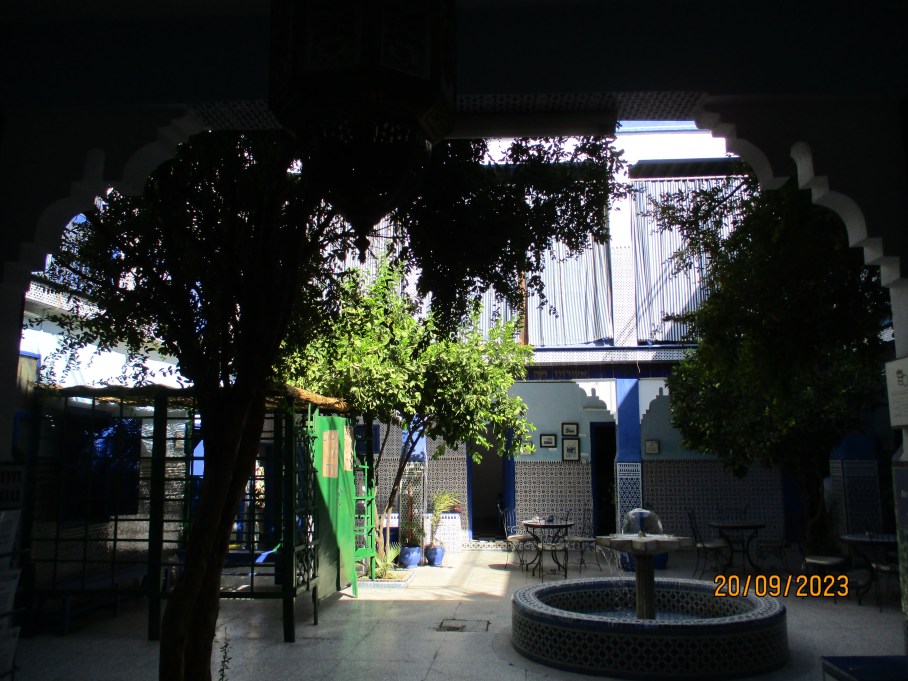
The synagogue is built in the traditional style of a riad with a a central courtyard with a fruit tree. The name Al Azama translates as “ those who ran away from Spain.” It dates from 1492 but was later rebuilt in 1956. The courtyard is decked in blue and white tiles called zellige.
Several rooms around the courtyard now serve as a museum, each room showing different aspects of Moroccan Jewish history. One has an exhibit of the Berber Jews of the Atlas Mountains. 2,000 years of Moroccan Jewish history are represented in fading colour photographs, documents and videos.
As we continued through the Mellah to the traditional spice markets for me to buy spices and especially saffron,the souk started to liven up and although not so manic as perhaps it would normally be, the locals seemed determined to get on with their lives after the earthquake.
A few days later as we took a taxi away from our hotel towards the Palmeraie we had the full sight of the storks of Marrakesh standing tall and serene in the ruins of the 16th Century Badia Palace. Storks often symbolize rebirth and new beginnings. It was easy to compare the people of Marrakesh rising back up from the ruins created by the earth quake like the storks, starting again standing tall and once again strong.

Death of a Fisherman

Are you looking for me with those dark eyes?

Can you not see me?

I am here, down in the river, flowing around the fish that swim.

Here in the water.

In the river that took me.

Why does your heart yearn for a sign from me?

I have given you many,

I am the kite that glides across the sky of the hill.

I whisper through the breeze

That swirls through the trees.

Can you not hear me?

Why are you wanting my arms to hold you again?

Can you not still feel me?

As I embrace you here while you sit and watch me flow by

Around in the pools and the swims.

Open your arms to me.

Do not cry, do not grieve, I am here where I wanted to be,

Down in the river, and so very happy.

I am dappled in sunlight, dancing through the leaves of all the trees.

Come and sit with me.

When ever you feel sad and yearn for me.

See me, hear me, feel me, love me.

Come down by the river where I will now always be.

Like the carp in the river weed,

I will never be caught.

I will forever be the one that got away.

I am the silver droplets on the kingfisher’s deep turquoise.

I am the king of fishermen now, I am who I always wanted to be.

Do not grieve, you can still love me.

But I am free, I am now forever free.

Corpus Christi Carpet of Flowers – Arundel.

Corpus Christi is also known as the Solemnity of the Most Holy Body and Blood of Christ. It is celebrated across the world in the Roman Catholic Faith on the Thursday after Trinity Sunday. The reason for the day Thursday is that this was the day of the Last Supper when Jesus and his disciples ate their last meal together.

Most devotees celebrate the event by taking bread and wine which represent the body and blood of Christ. It is known as a jubilant festival because it celebrates the transformation of the bread and wine into the physical form of Jesus.

The first Feast of Corpus Christi was introduced in Spain in the 13th Century by Santa Juliana of Liege.

In the Church of England the same day is known as Thanksgiving. The celebration of Corpus Christi declined in the UK by the 1970’s. But there are a few places that have continued to celebrate in some shape or another.

One such place is Arundel in the South Downs,West Sussex. But there is something very unusual about the celebration of Corpus Christi in Arundel’s Cathedral. It is celebrated with a carpet of flowers.

The carpet is created by an army of volunteers. It fills the full length of the central isle of the Cathedral. 90ft long. Every year it has a different theme for the design. This year it celebrated 150 years and that was reflected in the floral design.

It was the 15th Duke of Norfolk, Henry Fitzalan- Howard who introduced this beautiful celebration to Arundel in 1877. He had been on a visit to Italy and in a village 30 miles from Rome, a place called Sutri he saw a carpet of flowers.

The flowers symbolise paving the way for the King of Kings. They are a sacrifice to God. In villages in Italy they still celebrate, with streets carpeted in flowers which are later destroyed by the resident children.

My visit was a little more British. We were not allowed to walk on the flowers. The 7th June was its unveiling. The 8th June will be the actual Mass.

The Cathedral only achieved that status in 1965, but Arundel has a history dated back far longer then that. And with a Castle that spans 1047 to date its a has an amazing living continuous history.

From Flying Sauce Pans to Flying Saucers – Hidden Leatherhead

From Flying Saucepans to the Kit Kat Club – Hidden Leatherhead

Leatherhead is one of those towns that many of us are either just passing through on the train, or because there has been an accident on the M25 we are driving through just to get to another destination. There is little chance that unless you lived there, would you have any interest in stopping off to pay a visit.

I recently found myself back on public transport and the first part of my journey to work is now taking the infamous and occasionally elusive number 21 bus from Box Hill to Leatherhead. To then get the train. So initially I was one of the many people just passing through Leatherhead on my way to somewhere else.

But when someone else is at the wheel on a journey, we as the passenger have time to sit and stare and ponder on what is outside the window. When I travel abroad, I often take a bus to “anywhere” just to see where “anywhere” is. On a trip in Lebanon, I ended up in one of the strong holds of Hezbollah. With a very confused bus driver staring at me as he switched the ignition off, ready to head off home for the night.

The journey now from Box Hill to Leatherhead has become a bit of a revelation to me. There are so many impressive buildings along the way, that clearly reveal a life of wealth and privilege. With little or no real knowledge of the town I started to investigate Leatherhead’s past.

One by one each house became a character in the history of a town that I came to realise had a very unusual and eccentric past. A past where great writers found inspiration to put pen to paper, (or for one young resident extreme tactics to escape the middle-class boredom), and great engineers retired to homes built to their own special designs.

Heading down from Box Hill across Headley Heath is the imposing red brick building called Headley Court originally an Elizabethan farmhouse. It was purchased by the Cunliffe family of Tyrells Wood and Lord Cunliffe turned the building in to what it is today. He was the Chairman of the Bank of England from 1913 – 1918.

From WW2 till its closure in 2018 the Court was the rehabilitation centre for service men and women from the Joint Forces and the Royal Air Forces. More recently, during the pandemic it treated patients suffering from long COVID. Now in in 2023 the plans have been agreed for its next transformation into an integrated retirement community. Incredible to conceive that this building has put a roof over peoples heads for over 400 years.

The road down to Tyrells Wood Golf club is flanked with fields of green, dotted with small, wooded Copses. From where the deer graze relatively undisturbed and red Kites hover above.

Tyrells Wood is a bastion of the old Stockbroker classes who moved to their big houses. Just far away from London to live the life of privilege but a trains journey back into the city where they made their money.

There are many golf Clubs in the area but Tyrells Wood is recognised as one of the finest in Surrey. The Grade II listed Club House was built by Roger Cunliffe in 1880. Yes, the same Cunliffe’s up at Headley Court.

In 1924 James Braid five times Open Champion and respected golf course designer, transformed the land into what it is today. Even someone who is not a golfer cannot but admire the stunning landscape that has virtually remained unchanged for what will next year be 100 years.

As we head down to Highlands Road. Another much newer Golf Club can be seen in the Old Lord Beaverbrook Estate. There is a hint of what his greatest contribution was to this country etched in the green hill by the entrance to the estate. A spitfire.

Lord Beaverbrook was the War Time Minister of Aircraft Production. He trebled the production of the Spitfire, and it was with these planes that the Royal Airforce was victorious at what was the most famous – Battle of Britain.

Many younger readers would not perhaps have heard of the “Saucepans for Spitfires campaign.”. Housewives across the country willingly gave up these aluminium cooking implements to be melted down for production of Spitfires. A small price to pay in the war efforts.

It is no surprise to hear that Beaverbrook was a close friend to Winston Churchill. And his estate was an alternative war bunker hosting on several occasions the entire war cabinet.

There are many homes on the outskirts of the town that are reminiscent of Leatherheads wealthy past. And as a writer I am always interested in writers who have either resided in the area or have been influenced in their writing by the place.

In 1904 a school was established for the daughters of wealthy residents. It was called Leatherhead Court on the Woodlands Estate. One young lady who resided there for a while was Jean Ross.

Jean found life in Leatherhead Court so stifling that she pretended to be pregnant in the hope of being expelled from the school. She certainly went on to lead a much more exciting life. Becoming a war correspondent in Spain during the Spanish Civil War. At one stage whilst in the Weimer Republic she was a cabaret singer and actress in Berlin.

Her life in Berlin inspired Christopher Isherwood’s 1937 novella Sally Bowles. Which was adapted into the stage musical Cabaret. Isherwood delayed the publication of Sally Bowles for fear that Jean would sue him.

Driving down through Highlands Road there is the spectacular building on the left that catches the eye. Now called Lavender Court – The Royal School for the Blind as it was called for many years.

In 1901 SeaAbility was moved here from their original home in Southwark. An impressive red bricked building built in 1902 it stands amid tall pine trees. I remember well my first day working there. I was blindfolded and taken around the building to experience exactly how a blind resident would have felt on their first day arriving there.

I also remember when Princess Diana who was patron of the school made a visit in 1995 on a cold grey day in January. There was such a buzz of excitement. Today the site is called Lavender Court and Beechwood. And the buildings are residential properties.

At the bottom of Highlands Road stands Saints Church, dating back to the 11th Century it is a grade II listed building. As a young girl an urban myth went round my school in nearby Epsom that the grounds of Saints Church were haunted by a monk.

Now as I near the end of my journey into Leatherhead. I catch a glimpse of the house that started me on this quest to find out more about Leatherhead. “The Chateaux”.

I was immediately struck by the French influence of the building. I assumed it was perhaps something to do with the French Huguenots that fled the French revolution Of 1789. I am half French so anything French in an other wise very English environment will always attract me.

However further investigations at the Leatherhead Museum revealed I was off course with this building but not totally. The Châteaux was built by James Barlow. He started his early life as a tin plate worker.

He became an inventor and designer. And in 1851 he exhibited at the Great Exhibition in Paris. And later at the Crystal Palace in 1854 and 1862. (Although oddly he died while the 1862 exhibition was in progress.)

The Châteaux was built in 1850. And was originally called Wood Villa and a stone set in the wall at the back of the house where a wrought iron balcony painted blue reminiscent of again France, reads “WOOD VILLA – THE FIRST STONE WAS LAID BY MR JAMES BARLOW 1850.”

By 1854 James had entered an advert in the Daily News to let the property out. It lists – drawing, dining and breakfast rooms, four bedrooms and bedrooms for four servants, coach house, two stall stable, wash house, brew house, pleasure and kitchen gardens. This must have seemed a palace in Leatherhead at the time.

As we head into my stop at the crescent. Mansion House now the library and Register Office. In 1588 Edmund Tylney lived there he was Master of the Revels to Queen Elizabeth. The Queen dined with him there on 3rd August 1591.

If the name rings bells to readers that would probably be because the Weatherspoon’s pub is called The Sir Edmund Tylney. And has a very good visual display of the history of Leatherhead on it walls.

On the corner of Church Street is the delightful Hampton Cottage today home to the Leatherhead Museum.

And now I must alight a walk to the station to catch my train to work. But I pass Sweech House in the ancient street of Gravel Hill. Now home to my solicitors TWM but the blue plague reads that this is one of the oldest houses in Leatherhead, dating from the 15th Centaury.

And now it time for me to leave Leatherhead. Just passing through to some where else.

I leave you with a quote from H G Wells – War of the worlds. “Leatherhead is about twelve miles from Maybury Hill. The scent of hay was in the air through the lush meadows beyond Pyrford, and the hedges on either side were sweet and gay with multitudes of dog-roses. The heavy firing that had broken out while we were driving down Maybury Hill ceased as abruptly as it began, leaving the evening very peaceful and still. We got to Leatherhead without misadventure about nine o’clock……..”

Flying Saucers from Mars – Flying Sauce Pans from Leatherhead. I can see how easily the two become war zones. Amazing what the imagination can do.

Crossing the line of decent human behaviour.

I am going to deviate from my subject of a writer’s life this week. Those of you that don’t like Jack Reacher, stop reading now. I may just about to offend!

My blog this week is going to be about, “Our Boys in Blue”.

The reason is of course is obvious. Black Lives Matter.

The events unfolding both here and across the USA have revealed something in our society that has made me extremely uncomfortable and I am going to explain why in way very personal and pertinent to me.

So let’s start by saying I am white.  I am a woman of a certain age who lives on her own with no children and I hasten to add no cats. I have for the most part of my boring existence on this planet escaped any interaction with the British Police Force, except whilst working as a football steward as venues such as Wembley.

But life is a funny thing. Just as you are planning a retirement to the South of France your world can change irrevocably. And so the last three or four years I have had more contact with the boys in blue then a woman of my age should be have had. Or really would want to have.

As a result of my own behaviour I have come in contact with the Police on at one stage a regular basis. Some of my friends know some of the story, many of my neighbours know part of the story. No one knows the full story.

I have lived in a village for almost seventeen years. The first fifteen years I slipped under the radar but then for two years I have had more visits from the police then I should even be admitting to.

You are probably thinking I would be one of those individuals up in London attacking the police and destroying other people’s property and throwing bricks at horses. You would be wrong totally.

I am struggling to get my head round the events over the past week. Really struggling. What happened to that man in the USA was totally out of order. Of course it was. And people protesting initially made sense.

But these people are not protesting they are rioting. If it was about racism, well that point has been lost beneath the orgy of looting, violence and anti-social behaviour that has prevailed.

After all of the incidents where the police have arrived at my door I still have the utmost respect for them. And ultimately they have helped me get my life back on track. Although I was not actually knocking of the gates of prison, I was getting pretty damn close.

My behaviour was unacceptable, it was stupid, dangerous and on occasions totally insane. Fortunately I was willing to see that for myself and not to blame events for my predicament on the invasion of the Vikings in 870 for my predicament here in the 21st Century.

We are living through some very strange times. And our lives over the past few months have been taxing in the extreme. Our future remains unsettled.

But has the lockdown obliterated all common decency in certain individuals? Watching scenes of angry riots and unnecessary violence towards our Police Force has left me a little bit ashamed to be English.

Scenes of throwing bricks at horses, left me sickened. OK. life is not going the way we wanted it to, or hoped it would. But what level of intelligence do people operate at to think violence is going to get them what they want?

The Police Force are not our punch bags to use when we are angry disappointed or disillusioned with things. Looting shops and attacking other people is just as bad as the incident that has sparked these riots.

I just don’t feel those marches are actually about Black Lives Matter really. They are about a society that has begun to implode. That has crossed the line between decency and anarchy.

For those of you still reading and waiting for mention of Jack Reacher there is nothing more. I just used him to grab some readers’ attention.  I am as I said a dull, boring, white woman of a certain age, with no cats. I needed something to draw you in.

But I still have respect or our Police Force. Guys stop crossing that thin line. They deserve better then what they are receiving at the moment.

The Dark Side of the Hill

From the journals of Layla Lotawn

(Read out in the trial of June 25th, 2021)

On first meeting, Troy had the appearance of a down on his luck eccentric. Sometimes his dress bordered on tramp. Throughout the summer and the early autumn, he was always in shorts and a T-shirt. Some days it was obvious that the same clothes had been worn too many days in a row. He was painfully skinny, not a part of his body had a layer of fat. Yet he was not physically fragile, there was a sinewy strength to his body that suggested something alive and strong. He had the look of someone who needed a woman to look after him, to care for him. Working out in all weathers as a builder he had a leathery wind harassed face. Sometimes bearded and sometimes clean shaved, as if suddenly remembering his appearance was important, if not to him, to someone else.

However, his speech suggested something entirely different. He was well educated, erudite and sharp witted. A sharpness that could cut you down in a few words. Dangerous, a dangerous kind of wit. It was something that I could not reconcile with his outward demeanour, the eccentric tramp and the cruel narrator. Two sides to his character, clothes that gave the impression of kindness and another, words that gave the impression of a cruel manipulator.

Chapter 1 – Troy Buckley

When Troy first set eyes on Layla at the bus stop that summer morning he was fascinated by her. She was almost ethereal – not of this world. Not really living in the real world that was for sure. She seemed untainted by all the trappings of society. But she was also the most unapproachable woman he had ever encountered.

And it was then, as he looked at her that something cruel and feral roused itself in him. He wanted to bring her down to the dirt, to smash her, to destroy her, to make her just like all the other women he had encountered.

“Faint heart never won fair maiden.”  Never truer a saying was that on that first morning he encountered her. She barely spoke to him just raising her head from the book she was sitting reading. Later he saw that book on her kitchen work surface and remembered the title and the front page – “The Terror”, with a depiction of a cold artic landscape with ice trapping a ship.

At the time, he didn’t give it a second thought. Of course, she would hide her head in books, because she certainly didn’t seem so good at making conversation. What surprised him at that first meeting was how she affected him.

Troy was down on his luck, he was desperately in need of a daft, single, woman, living on her own whom he could smarm his way in to her life and ensure that he was in a warm, comfortable place for winter. Someone he could manipulate, mess with their head and control.

He could see that Layla was not that woman. She had a coldness about her, but also a strength that he thought could and ultimately would defeat him. She was not the easy way out and yet he wanted her. Suddenly it was such a powerful need in him, greater than his need for alcohol. The demon that ruled his life changed to something of a more curvaceous and sensual form.

Another step in the journey to being published – moving on from rejection.

For the last few weeks some of you have been following my journey as a writer since I got myself a literary agent. And its been an exciting journey, one from which I am learning every day. What I realise now is writers need a hefty dollop of self-belief. Something that does not come easy for me.
I began last week with feelings of self-doubt and disappointment, but I am beginning this week with enthusiasm and a small amount of self-belief.
My agent Wendy has pitched my book to I think about 10 publishers over the last few weeks. Some of them are the biggest publishing houses in the world. It was a humbling experience even to think that my work was being read by people in these houses.
When Wendy informed me that I had been rejected by one last week. Of course, I had a dream that several publishers would be fighting over me. On my confident days I believe I am an absolute genius. So, to be rejected was well a disappointment.
Trawling through the number of rejections for some very successful writers is always a great way to remind yourself not to give up. People constantly mention J K Rowling to me. That’s is such a great example. But there are so many more that.

Gone with the wind by Margaret Mitchell was rejected over 40 times. That went on to become the second most popular book in America after the bible.
I use that one as example because that actually says more about the determination of the writer then it does about the publishers who rejected her. One rejection is just a tiny drop in the ocean of disappointments. Margaret must have been one hell of a determined woman to keep going.
One publisher wrote about – The Diary of Anne Frank, “The girl doesn’t it seems to me, have a special perception or feeling which would lift that book above the “curiosity level”.” What a great example of someone in the wrong job.
A few years ago, I went to a Writers and Artists event to learn about self-publishing. There was a man in his 60’s who had in his hand what looked like a manuscript for his book. But I was stunned when he said, “No these are all my rejections of my book. Over 200 of them”
200 rejections! I tried to imagine at what point I would have said well no obviously I am never going to get this thing published, 40, 50,60? The guy seemed to have prided himself on so many rejection slips.
I am still undecided if it was true self belief or incredible determination. Or maybe both.
This was in the days when I was writing Jewish Days Arab Nights. I am embarrassed to say after less than 10 rejections I self-published it. I thought life was too short (it is) to be waiting on someone to recognise my talent.
This weekend I spoke with my Agent Wendy on the phone and we had an encouraging talk. She still thinks I have something. With that in mind I spent another weekend in lockdown writing and was thrilled to post on Facebook on Sunday that I had finished the first draft. I cannot describe the sense of achievement and the feelings of satisfaction this has given me.
There are various factors which have contributed to this and one of them is the enforced lockdown for me at weekends. Usually I would be working as a football steward at Wembley. I job that I have learned to actually enjoy. In small doses, that is. Not as much as I enjoy writing or reading.
So, my weekends have been filled with time to write. And most of the time I have enjoyed writing this book. The idea for the book came from the fact I was being gossiped about in the village where I live. Each step of my road to success is the proverbial finger to those people.
And another huge contribution is having a literary agent. Her encouragement and belief in me has been inspirational. I had often read articles about whether an agent was necessary for a writer to become published. Well for me the answer is undoubtedly yes.
Not only in her encouragement but also in her help to work through aspects of the book and the fact she has pitched my work to publishers I just would never have considered because they are so big. But there I am being read by the big guys.
She also reminded that my body count was a bit confusing. I think my serial killer lost count somewhere along the line. Too many bodies, not enough bodies. A simple mistake but one that Wendy spotted quickly.
My confidence has come back in spades (often used to dig the holes to hide the bodies on the hill.) I now just think enjoy this moment, enjoy the opportunities, enjoy the creative process, enjoy, enjoy it all.
And finally encourage any fellow writers. If you don’t have self-belief why would anyone else believe in you. You are the one holding the pages, you are the one that is writing the words, and if you don’t believe you can do that then how ill any one be able to read the end result called a book?
Perhaps not go as far as the guy with over 200 rejections. Although I am renowned for being stubborn. I prefer to call it determined.
I am still on the road to success. The next stage is now to start the re-writes, explanations, embellishments improvements. Hopefully by the end of this 2nd draft my agent may have good news for me.
I am however going to use this first rejection as bench mark for any future rejections one thing they did say was, “She didn’t like my style.” I like my style and am sure my fans do as well.

Actually, to be honest I didn’t think I had style so that is a bonus to find out I have style. I got style baby oh yes I got style, so there.
So, it’s business as usual for this writer. Happy writing folks! Oh, and did I tell you I am genius?