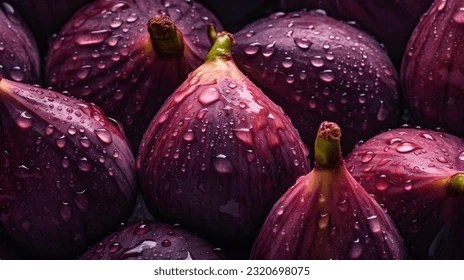
From Palestine to Sheffield – the journey of the sensual fig.

“Then Isiah said. Take a cake of figs.” Kings 20.7

Although fig rolls originated in Egypt, created by wasp haters, slowly by centuries and miles they became a classic biscuit and made their way to the Industrial North of England – Sheffield. How did this happen?

How could the fruit of a plant that had its very roots in the Garden of Eden travel so far from home and thrive in what was once a phosphorus smog filled city called Sheffield? A place described by George Orwell in 1936 – “And the stench! If at rare moments, you stop smelling sulphur it is because you have begun smelling gas. Even the shallow river that runs through the town is-usually bright yellow with some chemical or other. Once I halted in the street and counted the factory chimneys, I could see;” 

The fruit of a fig has its very own insect to pollenate the fruits. Unsurprisingly they are called fig wasps. And each variety of fig has its own special little wasp. There are nine hundred species of figs and so of course nature dictates there must then be nine hundred species of fig wasps.

Figs or fig trees are mentioned in the Bible almost two hundred times. Even Jesus mentions them. It makes sense that the tree would travel through the desert with the Israelites and thrive in Egypt.

As previously mentioned, it was here in Egypt that the wasp haters invented fig rolls. Hieroglyphics in the tombs in the Valley of the Kings show the harvesting of figs and it is common for dried figs to be among the items archaeologists find on their digs. Tutankhamun’s rolls would be different from todays; the process would be similar. The preserved figs would have been hand rolled with honey and spices in a floury dough and baked.

How did the fruit get to Britain, well as usual via the Romans. But it was from figs already pollinated so the assumption is there were no fig wasps in the country back then and therefore no cultivated trees. In 1552 Cardinal Pole -later to become the Archbishop of Canterbury planted a fig tree in the garden of Lambeth Palace, brought back from his time in Italy.

By the 17th century figs trees were common. Fig rolls at this stage were made at home. There are several theories on the origins of fig rolls being commercially produced, with different countries and companies claiming to be the creators.

Two main contesters for the accolade are McVitie’s and Jacobs.

Some historians believe that the Scottish biscuit company McVitie’s created the first fig rolls in the late 19th century. Developing a recipe for fig rolls that consisted of a sweet pastry filled with fig jam, and the company began mass-producing the pastry in the early 20th century.

However, there is also a school of thought which suggests that the Irish biscuit company Jacob’s created the first fig rolls in the early 20th century. Jacobs developed a recipe for fig rolls that again consisted of a sweet pastry filled with fig jam, and the company began mass-producing the pastry in the 1920s.

What is certain is that by the early 20th century they were a popular biscuit in the UK and throughout the World.

One section of society where they were extremely popular were the working classes. A convenient and affordable treat and the steelworkers in Sheffield were no exception. Once eaten the fig seeds would pass through the digestive system into the sewers and whenever there was a heavy storm a substantial proportion of the sewage overflowed into the river Don.

It is as this stage the vagaries of steel working came into play. The waters of the River Don were at a constant 20 degrees creating perfect conditions for the fig seeds to germinate and grow.

It is a very strange combination for such an exotic fruit to have survived in such a toxic unwelcoming environment as the Industrial North, human appetite, imperfect sewage, and the steel industry.

Today there are many distinct types and variations to choose from, each with its own unique characteristics and ingredients. Some of the most popular types of fig rolls include:

  • Traditional fig rolls, which consist of a sweet pastry filled with fig jam.
  • Nut-filled fig rolls, which are filled with nuts and spices.
  • Sweet fig rolls, which are filled with sweet fig jam and topped with sugar.

Fig rolls played a significant role in British cuisine and culture, particularly in the late 19th and early 20th centuries. They were seen as a quintessential British snack food, and their popularity was closely tied to the country’s industrial and cultural heritage. Fig rolls were often associated with traditional British values such as thriftiness, simplicity, and practicality, and they were seen as a comforting and familiar treat that could be enjoyed by people of all ages and backgrounds. The popularity of fig rolls also reflected the British love of sweet and savoury flavours, as well as the country’s rich tradition of baking and pastry-making.

Figs have been mentioned in literature and poetry for centuries including Shakespeare, Chaucer, Dickens, and D H Lawrence.

It is possible to create delicious and authentic-tasting fig rolls in your own kitchen. To make fig rolls at home, you will need to start by making the dough, which typically involves combining flour, water, and yeast, and then kneading the mixture until it becomes smooth and elastic. The filling can be made by cooking down fresh or dried figs with sugar and spices and then mixing in other ingredients such as nuts or seeds. The dough and filling are then assembled and baked until golden brown, resulting in a delicious and flaky pastry.

But make sure to use high-quality ingredients, including fresh figs and real butter or oil, to give your fig rolls the best possible flavour and texture. Second, be patient and do not rush the process, as making fig rolls can be a time-consuming and labour-intensive process. Third, experiment with different ingredients and flavour combinations to find the one that works best for you. Finally, do not be afraid to try again if your first batch of fig rolls does not turn out as expected.

Today if walking along the river towards Meadowhall, there are about thirty mature fig trees, some about 70 years old. A local Sheffield naturalist and amateur industrial historian Richard Doncaster discovered these. He along with a local botanist Margaret Shaw, fellow botanists from the Sorby History Society investigated the trees and confirmed they were indeed Fig trees and had the trees registered to ensure their protection.

From Palestine to Sheffield – the journey of the sensual fig.

“Then Isiah said. Take a cake of figs.” Kings 20.7

Although fig rolls originated in Egypt, created by wasp haters, slowly by centuries and miles they became a classic biscuit and made their way to the Industrial North of England – Sheffield. How did this happen?

How could the fruit of a plant that had its very roots in the Garden of Eden travel so far from home and thrive in what was once a phosphorus smog filled city called Sheffield? A place described by George Orwell in 1936 – “And the stench! If at rare moments, you stop smelling sulphur it is because you have begun smelling gas. Even the shallow river that runs through the town is-usually bright yellow with some chemical or other. Once I halted in the street and counted the factory chimneys, I could see;” 

The fruit of a fig has its very own insect to pollenate the fruits. Unsurprisingly they are called fig wasps. And each variety of fig has its own special little wasp. There are nine hundred species of figs and so of course nature dictates there must then be nine hundred species of fig wasps.

Figs or fig trees are mentioned in the Bible almost two hundred times. Even Jesus mentions them. It makes sense that the tree would travel through the desert with the Israelites and thrive in Egypt.

As previously mentioned, it was here in Egypt that the wasp haters invented fig rolls. Hieroglyphics in the tombs in the Valley of the Kings show the harvesting of figs and it is common for dried figs to be among the items archaeologists find on their digs. Tutankhamun’s rolls would be different from todays; the process would be similar. The preserved figs would have been hand rolled with honey and spices in a floury dough and baked.

How did the fruit get to Britain, well as usual via the Romans. But it was from figs already pollinated so the assumption is there were no fig wasps in the country back then and therefore no cultivated trees. In 1552 Cardinal Pole -later to become the Archbishop of Canterbury planted a fig tree in the garden of Lambeth Palace, brought back from his time in Italy.

By the 17th century figs trees were common. Fig rolls at this stage were made at home. There are several theories on the origins of fig rolls being commercially produced, with different countries and companies claiming to be the creators.

Two main contesters for the accolade are McVitie’s and Jacobs.

Some historians believe that the Scottish biscuit company McVitie’s created the first fig rolls in the late 19th century. Developing a recipe for fig rolls that consisted of a sweet pastry filled with fig jam, and the company began mass-producing the pastry in the early 20th century.

However, there is also a school of thought which suggests that the Irish biscuit company Jacob’s created the first fig rolls in the early 20th century. Jacobs developed a recipe for fig rolls that again consisted of a sweet pastry filled with fig jam, and the company began mass-producing the pastry in the 1920s.

What is certain is that by the early 20th century they were a popular biscuit in the UK and throughout the World.

One section of society where they were extremely popular were the working classes. A convenient and affordable treat and the steelworkers in Sheffield were no exception. Once eaten the fig seeds would pass through the digestive system into the sewers and whenever there was a heavy storm a substantial proportion of the sewage overflowed into the river Don.

It is as this stage the vagaries of steel working came into play. The waters of the River Don were at a constant 20 degrees creating perfect conditions for the fig seeds to germinate and grow.

It is a very strange combination for such an exotic fruit to have survived in such a toxic unwelcoming environment as the Industrial North, human appetite, imperfect sewage, and the steel industry.

Today there are many distinct types and variations to choose from, each with its own unique characteristics and ingredients. Some of the most popular types of fig rolls include:

  • Traditional fig rolls, which consist of a sweet pastry filled with fig jam.
  • Nut-filled fig rolls, which are filled with nuts and spices.
  • Sweet fig rolls, which are filled with sweet fig jam and topped with sugar.

Fig rolls played a significant role in British cuisine and culture, particularly in the late 19th and early 20th centuries. They were seen as a quintessential British snack food, and their popularity was closely tied to the country’s industrial and cultural heritage. Fig rolls were often associated with traditional British values such as thriftiness, simplicity, and practicality, and they were seen as a comforting and familiar treat that could be enjoyed by people of all ages and backgrounds. The popularity of fig rolls also reflected the British love of sweet and savoury flavours, as well as the country’s rich tradition of baking and pastry-making.

Figs have been mentioned in literature and poetry for centuries including Shakespeare, Chaucer, Dickens, and D H Lawrence.

It is possible to create delicious and authentic-tasting fig rolls in your own kitchen. To make fig rolls at home, you will need to start by making the dough, which typically involves combining flour, water, and yeast, and then kneading the mixture until it becomes smooth and elastic. The filling can be made by cooking down fresh or dried figs with sugar and spices and then mixing in other ingredients such as nuts or seeds. The dough and filling are then assembled and baked until golden brown, resulting in a delicious and flaky pastry.

But make sure to use high-quality ingredients, including fresh figs and real butter or oil, to give your fig rolls the best possible flavour and texture. Second, be patient and do not rush the process, as making fig rolls can be a time-consuming and labour-intensive process. Third, experiment with different ingredients and flavour combinations to find the one that works best for you. Finally, do not be afraid to try again if your first batch of fig rolls does not turn out as expected.

Today if walking along the river towards Meadowhall, there are about thirty mature fig trees, some about 70 years old. A local Sheffield naturalist and amateur industrial historian Richard Doncaster discovered these. He along with a local botanist Margaret Shaw, fellow botanists from the Sorby History Society investigated the trees and confirmed they were indeed Fig trees and had the trees registered to ensure their protection.
Tales from the badger set.

“Spring was moving in the air above and in the earth below and around him, penetrating even his dark and lowly little house with its spirit of divine discontent and longing.” ― Kenneth Grahame, The Wind in the Willows

It seems fitting to start an article about badgers with a quote from Wind in the Willows, for it was with this book published in 1908 that the badger’s connection with the landscape and the people of Britain changed.

With Mr. Badger, Kenneth Graham created a character that slowly won the hearts of us all and eventually the badger became one of our most enigmatic wild animals in the UK.

Yet for many, the only time they see a badger is sadly on the side of the road dead. Whenever I speak to work colleagues I am reminded of Alan Bennet when his friend hits a badger whilst driving and after returning to the scene of the crime Alan realised that – “What particularly upsets him is that I have never seen a live badger – all the badgers I have seen like this one is now, a dirty corpse by the roadside. We drive on in sadness and silence.” ― Alan Bennett, Keeping On Keeping On

I am one of the fortunate ones for can I see badgers every day. Or every evening to be pedantic. When I first moved into the place I live now, I chose it because I was not a social person. I wanted to be close to my place of work but away from people and what I found instead was badgers.

My garden was part of those ancient badger tracks that meant manicured lawns and tarmacked drives would not and could not stop the journey that was imprinted in the very psyche of this strange allusive anti-social animal.

The first night I heard the sound of a badger shuffling through my place, I thought I was being broken into. The banging into the man-made structures of my home sounded like a burglar on a mission to just break in, take what they wanted and leave.

But when I looked out into the dusky darkness what I saw enthralled and delighted me, first I saw the grey shape of what appeared to be a cat with a stunted tail, and then the creature turned and I saw the face of a humbug.

I could barely contain myself a badger! The creature that so many bemoan about seeing dead by the road side was here very much alive in my garden, and very much on a mission to break into my home. And he was about six foot away from me.

And so it was from then, that my fascination with badgers started. I have to confess my first tactic was peanut butter sandwiches. Why? What myth or legend or story said badgers like peanut butter sandwiches? But they certainly did love them and that first night that is what I fed them.

Or to be precise I fed one. I never named my badgers, I notice that on blogs people name their badgers, but I just had a sense from the start they are wild. My first burglar badger 20 years ago, my sister called Jack until the time the two first cubs came down and so Jack became Jill.

Jill was not a good mother, the cubs died before the daffodils had barely danced and waved across the craters of the moon that now represented my garden. But I made the mistake of naming one, a scar faced male badger who lived, loved and fought on my now desolate land.

I worked long hours in those days and often at night completely shattered I would slowly walk back to my home to find a garden of badgers. Like a bag of humbugs thrown out of a bag they snuffled across the craters that should have been a lawn. And I would have to walk past them to get to my door.

Most showed indifference, they would raise their stripped heads and sniff the air, and then just ignore me, except one, who would catch my scent, Scar Face. And as I attempted to reach the door he would suddenly rear his head and like a tank barge his way towards me. I would just make it to a place of safety and shut the door.

If you want to anthropomorphic an animal then I did that with Scar Face. He was like the angriest belligerent teenage son you could have. One morning I heard what sounded like a raging bull kicking his way out of the enclosure into the rodeo. Scarface had got into the recycle wheelie bin and I had to get him out.

A battle that I did not want, a battle he felt he needed to win, but both reduced to compromise by a green plastic bin. He roared out of that prison like the wild animal he was.

And then I found him by the road side discarded like the grubby grey rug that Alan Bennett described. I recognised him by the scars, the years of fights etched on his face like medals. My last and first badger that ever I named lying dead on the road.

For they are wild animals. How many writers have given these wonderful secretive creatures characters like humans? Kenneth Grahams Mr Badger was just the start.

The first book at school that I brought was Watership Down and in that book there was a portrayal of a badger that was not wise and kind. He was the wild creature that he was born to be.

“Full of savage cunning”. He was wild, he was not a creature you would have in your living room. He was not the Mr. Badger of Kenneth Graham, that when Mole and Rat knocked on his door he so warmly but also so gruffly welcomed into his home.

And of course that is the reason he became the hunted, the animal no one could understood, the animal that would be blamed for all the problems that man encountered in the country side.

And this echoes the lines of poets like John Clare – Badger –

“When midnight comes a host of dogs and men Go out and track the badger to his den, And put a sack within the hole, and lie Till the old grunting badger passes bye.”

Badger baiting has survived into the 21st century. The most brutal practice – it is rather like fox hunting when Oscar Wilde said “the unspeakable In pursuit of the uneatable”

There are two things that a badger is afraid of – a man and a dog. For badgers, the two are merely extensions of the other. And ultimately it is the dog that pits its strength and wits against the badger. The man merely provides the circumstances to make it possible and becomes the malignant observer to the barbarity.

Badger baiting was very much the domain of the working class, in contrast to fox hunting which was for the landed gentry. Badger baiting was the opportunity for the uneducated and poor to take control of their own free time and inflict cruelty on a creature that the rich had no interest in and so therefore would never obstruct their sport.

Even today “badger experts” say, it can be a housing estate thing. They tend to be very vocal about their activities unlike country people who do it quietly.

It was never was it about feeding the poor. Except oddly people do actually eat badger – badger ham. This was something that I only found out 20 years into watching and feeding badgers, there are people that actually eat them. Those who have eaten it say it tastes like pork but sweeter.

There is a recipe from Germany that details how to boil badger meat with pears. And a century ago in England a badger feast was not unheard of. I have never heard anyone say to me they actually like it enough to eat it twice though.

And yet today we have culls to kill badgers purely to eradicate Bovine TB. Despite there still no conclusive proof that culls help eradicate Bovine TB the licence to cull badgers went ahead again in 2021.

So we have reached the strangest juxtaposition, we love badgers, but we are culling badgers, we run over badgers but we feed badgers peanut butter sandwiches.

Looking out on a foggy winter’s morning into my garden, I can see the remnants of the previous night’s badger’s feast. They had discarded the spring green leaves and tossed aside various items of food. But had snuffled their way through the bread with the meat fat poured over it.

Also chicken carcasses they love. It is eaten with enthusiasm, a great deal of noise, grunting and a crunching of bones. And of course my peanut butter sandwiches.

Yet whenever I hear about people that feed badgers it appears their badgers will eat anything. Mine must be Surrey Badgers, fussy eaters.

My abiding memory of a badger as a child was when reading Watership Down, Violet says – “It has just killed. I saw blood on its lips”

And Dandelion replies,” Lucky for us it had, otherwise it might have been quicker!”

To be fair they don’t seem to be that fast in my garden these days. But I do remember Scar Face pummelling towards me, like a Sherman tank that late summer evening, so many years ago. And having the battle with him stuck in my weelly bin.

And I think, stay wild.

“I’m a beast. I am and a Badger what’s more. We don’t change. We hold on.” CH Lewis

Please don’t change Mr. Badger, for you are the Story Teller of the Animal Kingdom. And what stories they have to tell.

The Flame Trees of Beirut

“It was like being bitten by a beautiful dragon fly whose wings were of such splendour that the victim did not even feel the nip in the flesh.” Robert Fisk – Pity the Nation Lebanon At War.


My first impression of Beirut was how much like Haifa in Israel it looked. The city tumbling down from the surrounding hills, buildings almost falling into the sparkling blue of the Mediterranean Sea.

Beirut was so much like Haifa that in the days preceding Israel’s aerial bombing of the city in 1982 the pilots used Haifa to practice its raids using that city as its dummy for the real thing.

The bombing of Lebanon by Israel and the subsequent slaughter of innocent Palestinian refugees in the camps by the Lebanese Phalanges shocked the outside world. Reporters and photographers sent harrowing scenes back verbally and visually that the west could not fully comprehend. And perhaps we could never understand.

The country continued over the years to be a hot spot for conflict and its capital  bombed to oblivion meant the hedonist city of Beirut was a place no longer on the tourist trail. My constant trips to Israel meant that even when peace was restored I could not visit.

And those that did visit said the city was destroyed, buildings left abandoned, bombed, burnt and razed to the ground. And of course the kidnappings and hostages all added to the reputation of Lebanon not being a place for your average traveller.

In the 21st Century, a country that had in Biblical times provided the cedar trees for Solomon’s Temple to be built in Jerusalem now had the monumental task of rebuilding its capital from the rubble.

And of course that is the first thing I noticed on my walk around the city, just how many abandoned buildings there were. And it was difficult to establish with any confidence which conflict had caused their destruction.

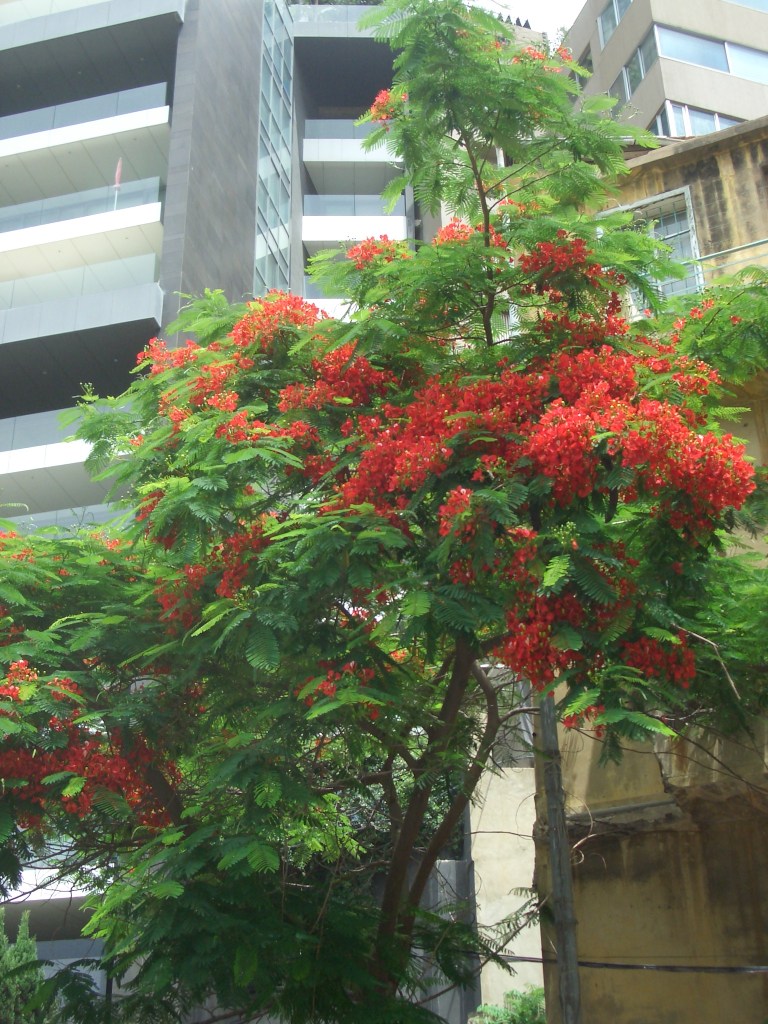
The hotel where I stayed near the famous Corniche abutted onto a cluster of such buildings. One hidden behind the veil of a huge overgrown flame tree was possibly from the Ottoman times, the wrought iron bars on the windows had rusted beyond repair.

The flame tree hiding the building was blooming later then many in Beirut. Probably because it was in virtual shade from the surrounding buildings. Over the week the leaves turned from pastel yellow, to orange and vibrant red.

Behind this ghostly beauty was an old apartment block. Three storeys high, it too had all the signs of being abandoned in a rush. Wooden slats on all the glassless windows had been virtually bleached white by years of sun and wind. One home at the top had geraniums growing from the window box. Spots of red like blood splayed across the peeling paint of the wall.

At dusk bats would flitter through the open doors and windows, flapping up into the balmy evening air. Sometimes they would fly close to where I stood on my balcony. Harmless little creatures, surviving in a place that once saw an aerial attack of a far worse and deadly kind.

I wondered did all of the occupants of the building make it out alive, running away before the attacks, or did they stay and endure hoping to survive? And what happened to them? Where did they go? Where are they now? What kind of life do they and their families have now?

Another building which appeared empty was an office block. The age of the building suggested that perhaps this was abandoned in a more recent conflict. It still had all the glass in the windows intact. Curtains hung yellow and dusty in some rooms. But at night there was always one room illuminated. Had someone set up home there? Electricity was obviously still connected, and perhaps running water. Was he security, or was he just someone who lived where he knew he would be left in peace?

Buildings like these are dotted all around Beirut. Some like the Holiday Inn have gaping holes in them from where the firing burst open the walls. The concrete edifice that the local calls The Blob, peppered with shell fire and bullet holes. Buildings left to ruin alongside the new rebuilds.

For many the re- building of Beirut is a great thing but I couldn’t but help think as they rebuilt the city, they were trying to re write their history, just like Haifa in Israel, slowly creating a sanitised city devoid of all the trapping of humanity. By my hotel there were old Arabic shops alongside a new air conditioned super market that sold new trendy products.

Many places I walked I felt I could have been in Brighton in England. The Arabic past not obliterated but absorbed by a Western conception of how the city should be. The souks of Beirut are now pristine tents set up in St Georges Bay selling designer items, pretty shiny things with no trace of the country’s heritage in their makeup.

There were on days when I have to confess I took a bus just to go to the outskirts of the refugee camp at Sabra. Just to look across that invisible line to see where a nation of persecuted and oppressed people lived. Just to remind myself I was in a country situated in the Middle East, between Syria and Israel.  That God forbid I wasn’t in Brighton.

This was the city where Israel in an attempt to obliterate a nation of people helped the Lebanese Phalanges in the slaughter of innocent children, women and old men. Have they chosen to forget?

By the end of my week in Beirut workers were putting the finishing touches on a new shiny tower block that overlooked the Corniche. Potted Palm Trees were being placed strategically along the entrance to the building. Yes I know what you are all thinking Potted Palm Trees in the Middle East!

I was vaguely reassured by the site of an old bombed out wreck of building next to it, plants that had gone wild and were slowly escaping down the balcony to freedom.


Next week Miss Walton gets accidently kidnapped by two bus drivers and taken up into the hills of Lebanon!

The last story teller of Marrakech.

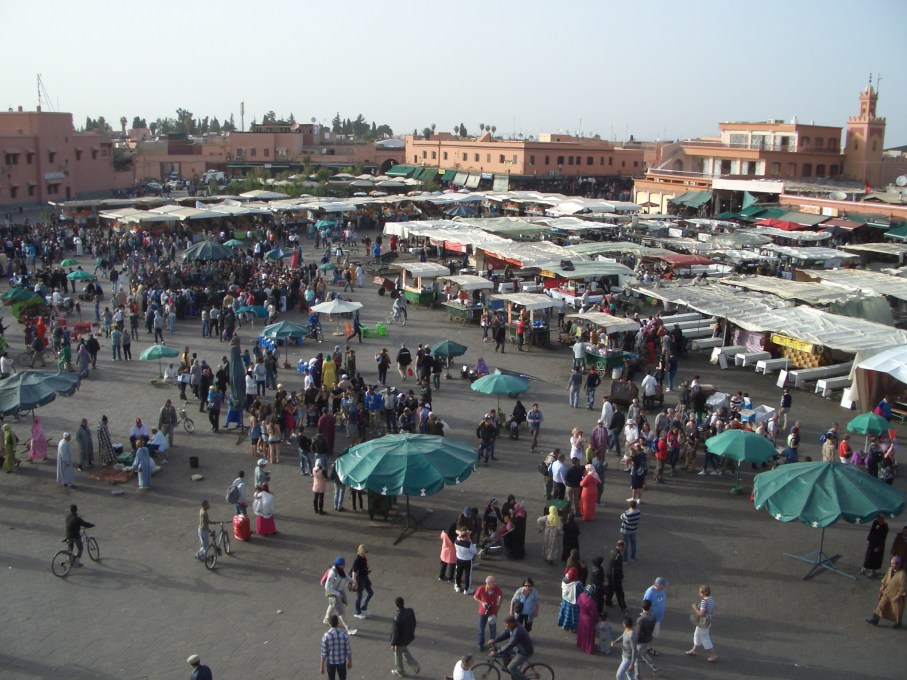
For centuries the square called Jemmaa el Fna in the city of Marrakech had been a place for the art of storytelling to thrive. People who could not read or write and did not have TV or computers, would come and sit and listen to a story being told and played out by a hlaykia – a story teller.

Now the new modern age of TV, Facebook, and computers means they have become virtually redundant. For me the thought of not reading the written word is unimaginable. I am sure in years to come there will be campaign for the last author.

Whilst on a recent sojourn in Morocco I was unwell. Fortunately I had enough books for me to just sit back read and also to write and so here is a very inferior modern story that I hope captures the spirit of the story tellers of Marrakech. For those wanting to read a more traditional example I recommend – Richard Hamilton –The last story tellers.


The rich baker of Azemmour.


Once upon a time in Azemmour, there was a young boy called Moulay. He dreamed of being rich. He lived in a small house inside the walls of the Old Portuguese Medina of Azemmour with his mother and his six brothers and sisters. He was happy enough, but he was restless and wanted more.

Often he would row his small wooden boat along the canal called Wadi Oum er Rbia, at the mouth of the estuary he would think of how he would sail a boat right through the white tipped waves of the Atlantic ocean and make his way to Europe. Where he could work and become rich.

He had heard of a city called London. That city had a river too but it had rich people’s boats sailing on it. And the whole of London had rich people living there.

Moulay began working in the communal bakery when he was twelve. This was a place where all his neighbours would bring their bread for the baker to bake their daily bread. Every one took their dough there, for people in the Medina did not have ovens to cook. They cooked meat on open braziers outside but bread was always taken to the baker.

Moulay worked hard, but his head was in the clouds. He still dreamed of London and being rich.

One day the owner of the baker came to Moulay with a very generous offer. “I have watched you these past few years and you work very hard Moulay. I have only daughters, no sons to pass my business onto. I am old and soon will not be able to work. I want you to have my bakery. I offer you my eldest daughter Fatimah as your wife. And then the bakery will become yours.”

Moulay knew that this was a very generous offer. Fatimah was pretty and very kind natured and would make a very suitable wife. But Moulay loved the younger daughter Rashida. She was more beautiful than Fatimah if not as kind hearted.

Whilst Moulay pondered over the request, one of his cousins paid a visit from Casablanca, that very French city further up the coast. His cousin flashed his cash and began to flirt with Rashida.

Mohammed took his cousin aside one day and whispered in his ear, “Rashida is too pretty for you, it will have to be a rich man for her.” This was something that Moulay knew was true he wished it wasn’t true but he knew Rashida was what the Europeans called – High Maintenance.

“But,” Mohammed continued, “I know how you can become rich, so rich you could afford two wives like Rashida.”

Moulay was all ears, money soon to be his, lots of it too.

“You have to be very brave and be able to sail a boat.” Mohammed said.

Moulay could sail a boat no problem. As to brave? All doubts were quickly dispelled about his courage at the thought of achieving his dream of being rich.

“What do you need me to do?” he replied to Mohammed, a growing feeling of excitement rising in him. He was up for the adventure.

“My boss has a very precious cargo that needs to be taken to Europe. I will arrange the time and place for you. All you have to do is sail the boat across the sea to Spain. Moulay thought that was easy. A boat can be sailed across the stretch of Mediterranean Sea no problem he deduced.

So one cold dark winter morning, Moulay left his mother and his siblings and headed further up the coast line to where he was told the boat with the cargo would be waiting for him.

But when he got there he was shocked and immediately had second thoughts. There was the boat low in the water, heavy with the cargo of people. Illegal immigrants headed for Europe in the hope of a better life.

Moulay nearly said, “No.”. But the lure of the money and having Rashida as his wife swayed him.

They were not going to sail across the Mediterranean Sea, as he had expected. Instead they were to sail up the north Atlantic coast and then to the south west coast of Spain.

The first few hours of sailing were easy. By now the sun was up and a cool breeze seemed to be pushing them to the direction they needed to go. I few of the men – for they were all men he had now established – were sea sick but that was to be expected.

But then a storm of such magnitude began and the waves were higher than the boat. Many of the men fell overboard; they quickly sank beneath the cruel sea. Their cries all but obliterated by the sound of the angry storm.

But somehow Moulay sailed on, driven now just with the will to survive and to hit land any land.

And so the boat did eventually hit land – the South West coast of the country called Spain. There was a lorry waiting for them to take them through Spain and France to Calais.

Moulay had not planned to go with them, not really for he had only planned to sail the boat to Spain. But he thought, Allah has got me this far. I will go on in the lorry to France.

The lorry did not stop very often and soon the water they had been supplied with was gone. The smell of the bodies all crammed in together was insufferable, and just when Moulay was about to give up, the lorry stopped one last time and opened up the doors.

The last surviving men staggered and fell out and began their last part of the journey to England.

Moulay in a semi delirious state noticed that the weather once again had changed. There was no blue sky and sun. Just grey skies and dampness, the continual drizzle of rain.

But he told himself, all would be OK once they reached London.

So hiding between the legs of sheep headed for England Moulay finally arrived in that country where dreams were made, where everyone was rich. But Moulay was not driven to London, he was driven further north to a place he could not pronounce. A place called Lincolnshire.

And here for several months he worked over 18 hours a day six days a week. For what even he knew was a pittance. And the misery of being on a farm, in the middle of nowhere nearly broke his resolve.

There was no sun to warm his bones. The caravan he lived in with 10 other men was cold and damp and soon began to smell.

In the short moments of sleep. He began to dream of Azemmour. The town where the sky was always blue and where a breeze from the Wadi carried the smells of cooking and the sound of laughter from the Medina. There was no call here for payer from the muezzin, just the call to work like dogs.

And so one night when he had woken up having dreamt of the smell of fresh bread from the bakery. The bakery that had he said yes would now be his.  Moulay prayed to Allah for help. He was not sure that he was praying in the right direction but he was sure that Allah would forgive him that one small transgression.

And Allah answered his prayers. “You must put your trust in authority Moulay.”

He pondered on what this meant. But then he knew. So he got up, and although as usual it was raining, he walked out of the farm, before the dogs were even up to bark a warning to the farmer.

He trudged through a field of heavy mud. And kept walking till he came to a road that was tarmac. Walking the road he came to a sign, with two arrows.  One with a long name he couldn’t read, but in brackets the number 25, and the other with a shorter name that he still couldn’t read with in brackets the number 15. He chose the direction with the shorter name and the smaller number and continued to walk.

Soon he could see the sprawl of a town or a city and he pushed on towards the place. Before he had made it to the outskirts of the town, a police car pulled up alongside of him.

He did not struggle, he climbed into the back of car willingly. And so without a passport, money or any form of identification Moulay took the long road back to Azemmour.

When he returned home, thinner, older and very much wiser, his mother cried that she thought he was dead. His sisters cried that they thought he was dead. His brothers cried they thought he was dead. And his cousin, rather less enthusiastically greeted him and with less joy said, “I thought you were dead.”

When he went to the bakery, Fatimah was still not married, she smiled a welcome to Moulay and her father shook his hand. He went to say, “I thought….”

Moulay interrupted him and sadly said, “Yes. I know you thought I was dead.”

Rashida had married Mohammed and was now pregnant. And although still very beautiful was now even more high maintenance and still not so kind hearted as Fatimah.

A year later he married Fatimah and became the owner of the bakery.

The only time Moulay thought of England again was when a grey cloud sailed across the blue skies of Azemmour. Or sometimes when a tourist walked past his bakery and stared in with curiosity. He would shudder at the memory of his time in England. He never spoke of his time in the country where the sun did not shine. He was grateful that Allah had helped back from the ends of the world and now looked forward to his future with less money but richer by far in many other ways.